
Travel Retail Alcohol Trends Driving New Duty Free Strategies
Discover how travel retail alcohol trends and RTD innovations are reshaping duty-free strategies ahead of the GTR alcohol rebound 2026.
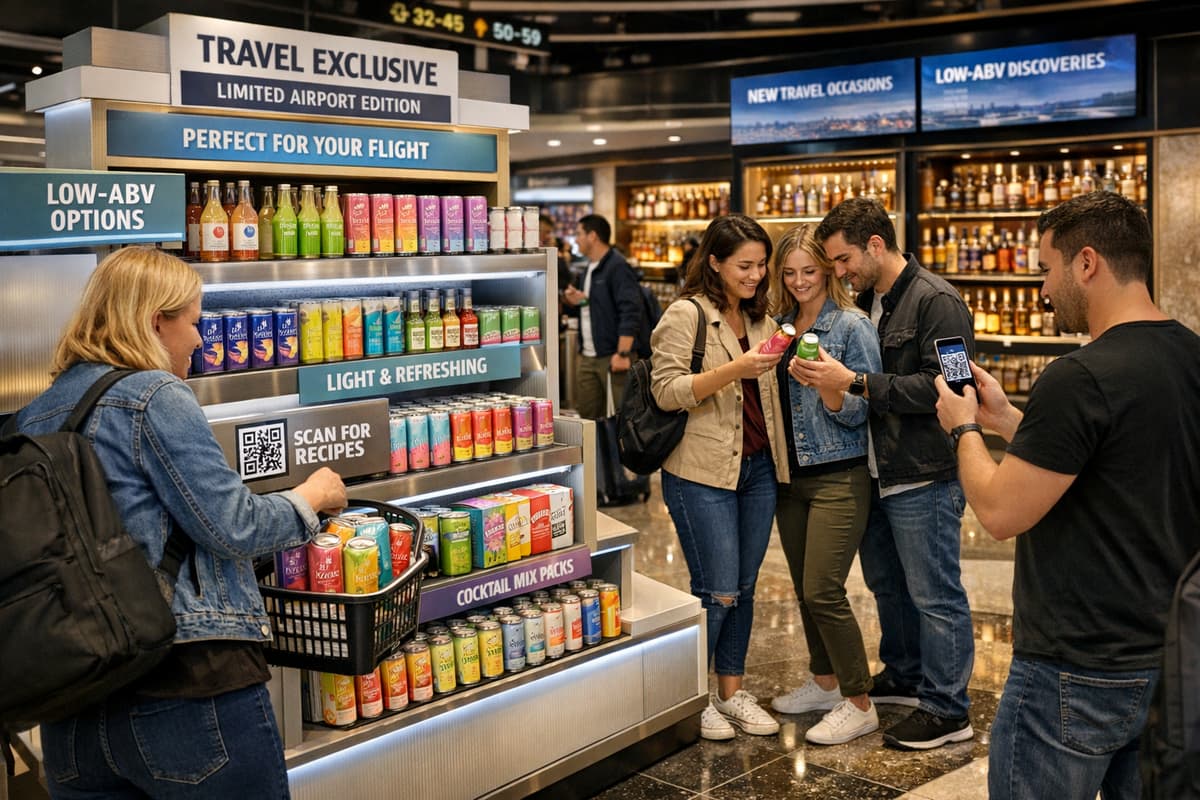
The traveler standing in duty free today is not the same traveler from 2019.
She moves quickly. He scans shelves faster than you refresh your sales dashboard. They are curious, distracted, price-aware, experience-hungry. And they are absolutely unimpressed by another static wall of premium bottles sitting like museum pieces behind glass.
If you’re leading travel retail strategy right now, you feel the shift in your bones.
The global market is pointing to $4.2 billion in projected growth by 2034. The GTR alcohol rebound 2026 is real. But here’s the uncomfortable truth no one wants to say out loud: rebate-fueled premiumisation alone won’t win it.
The brands that will dominate this rebound are executing sharper duty-free alcohol strategies. And quietly, almost invisibly, duty free RTD innovations travel retail are emerging as the stealth bombers of this new era.
Not loud. Not flashy.
Surgical. Precise. Profitable.
Travel Retail Alcohol Trends Are Shifting From Prestige to Precision
For years, the dominant narrative in travel retail alcohol trends was simple: go bigger, go older, go more exclusive. Limited-edition single malts. Oversized gift boxes. Luxury storytelling that practically glowed under airport lighting.
And yes, prestige still matters. It always will.
But walk through Heathrow, Dubai, LAX, or Changi today and watch what actually moves. Watch what lands in carry-on baskets instead of being admired and abandoned.
The shift is subtle but unmistakable.
Consumers aren’t just buying brands. They’re buying occasions.
Pre-flight relaxation. Beach arrival vibes. Hotel room wind-down. Rooftop reunion. And those moments often don’t require a 1-liter prestige bottle with a three-figure price tag.
This is where smarter duty-free alcohol strategies come into play. Not abandoning premium. But optimising the portfolio around how people actually drink when they travel.
And right now, RTDs are aligning perfectly with those moments.
RTDs: The Stealth Bombers of Duty Free
Let’s talk plainly.
The old guard sometimes calls RTDs “entry level.” Lightweight. Trendy. A bit of a gimmick.
That’s like calling streaming a fad while stocking DVDs.
Duty free RTD innovations travel retail are not fighting for shelf dominance through prestige. They are winning through frictionless relevance.
Think about their advantages:
- Portability: Easy to pack, easy to chill, no corkscrew drama.
- Moderation: Lower ABV options match mindful drinking behavior.
- Experimentation: Flavor-forward profiles encourage trial.
- Price accessibility: Lower spend commitment in uncertain economies.
That alignment is not accidental. It speaks directly to Gen Z duty free alcohol behaviour.
This generation isn’t impressed by heritage alone. They want taste exploration, aesthetic packaging, and brands that feel like companions rather than monuments.
If prestige whisky is a grand piano in the lounge, RTDs are noise-cancelling headphones on the plane.
Different purpose. Different moment. Massive opportunity.
The Real Battleground: Occasion Ownership, Not Shelf Space
Here’s where most travel retail strategies stumble.
They optimise for category share instead of occasion share.
That mindset belongs to the past.
The next wave of duty-free alcohol strategies is about identifying micro-occasions within the airport journey:
- Security relief moment: “I survived the queue.”
- Boarding gate boredom: “What’s something new?”
- Destination anticipation: “Let’s start the holiday now.”
- Gifting under time pressure: “Grab something cool, fast.”
RTDs perform exceptionally well in these spaces because they require less explanation and less commitment.
Premium bottles demand intention. RTDs invite impulse.
And during uneven global recovery, impulse conversion matters more than ever. Passenger volumes are climbing, yes. But spend per passenger varies by region. North America behaves differently from Asia. Recovery in China hasn’t mirrored 2019 patterns perfectly.
Precision beats assumption.
Which is exactly why duty free RTD innovations travel retail are becoming tactical tools rather than novelty add-ons.
Gen Z Duty Free Alcohol: The Data You Can’t Ignore
Let’s ground this in behaviour, not vibes.
According to broader industry reporting, including insights like Southern Glazer’s Top 10 Drink Trends from the 2026 Liquid Insights Tour, flavor innovation, moderation, and convenience dominate forward-facing alcohol growth conversations.
Now overlay that with airport psychology.
Gen Z duty free alcohol shoppers:
- Research less in advance.
- Browse more visually.
- Respond strongly to packaging cues.
- Value story, but only if it’s concise.
They are digital natives operating in physical retail spaces.
Which means your duty-free alcohol strategies must become hybrid - data-driven but emotionally resonant.
A sleek canned cocktail with a locally inspired flavor drop tied to destination storytelling? That’s magnetic.
A dusty prestige line extension with marginal age upgrades? That’s background noise.
And before anyone cries sacrilege - I love a 21-year-old single malt as much as the next founder. But love does not equal growth strategy.
SKU Mix Optimisation: Tactical Moves for GTR Alcohol Rebound 2026
The GTR alcohol rebound 2026 won’t reward brands that simply “wait it out.” It will reward those who re-engineer their SKU mix.
Here’s how smart operators are adjusting their duty-free alcohol strategies right now:
1. Impulse-Zone RTD Clusters
Rather than burying RTDs in category corners, position them near high-traffic flow corridors and checkout zones.
RTDs thrive where dwell time is short.
2. Limited-Run Travel Exclusives
Airport-only flavors drive urgency.
The scarcity principle works beautifully with duty free RTD innovations travel retail. Smaller pack sizes. Bold design. Clear “Only Here” messaging.
3. Low-ABV Portfolio Layering
Moderation is not a fad. It’s a recalibration.
Layering lower ABV RTDs alongside premium spirits supports dual purchases: one for gifting, one for personal consumption.
4. Data-Led Regional Adjustments
Different airports, different behavior.
Your duty-free alcohol strategies must respond to passenger mix, route patterns, and seasonality. No more one-size-fits-all rollouts.
This is where agile RTD portfolios outperform static prestige lines. They’re easier to rotate. Easier to test. Easier to localise.
Why Premium Alone Can’t Carry the Rebound
There’s a myth floating around in some executive corridors: that pent-up demand will automatically reignite ultra-premium velocity across all regions.
I’d love that to be universally true.
But growth is patchy. Currency pressures are real. Younger travelers are debt-aware and budget-conscious.
The future of travel retail alcohol trends is not anti-premium.
It’s anti-static.
When brands anchor their entire forecast on prestige SKUs without flexible layers beneath them, they create earnings volatility.
RTDs smooth that volatility.
They capture mid-tier spend. They invite trial from new legal-age travelers. They complement, rather than cannibalise, premium purchases.
It’s not war between categories.
It’s coordinated air strategy.
Building Duty-Free Alcohol Strategies for Occasion-Led Precision
If I were advising a travel retail board this quarter - and I have sat in those conversations - the roadmap would look like this:
- Audit occasions, not just categories. Map every airport journey touchpoint.
- Design RTD innovation calendars. Seasonal flavor waves tied to destinations.
- Integrate digital storytelling. QR codes linking to 30-second brand videos.
- Train staff differently. Short scripts focused on use-case, not heritage lectures.
These are practical, implementable duty-free alcohol strategies. Not theory.
Because the brands that treat RTDs as strategic assets - not shelf fillers - are already seeing stronger conversion in younger demographics.
And here’s the beautiful irony.
When RTDs increase dwell engagement and trial behaviour, halo effects often benefit the wider portfolio. The traveler who experiments once is more likely to trade up next trip.
This is long-game thinking.
The Bigger Picture: Reframing the GTR Alcohol Rebound 2026
The GTR alcohol rebound 2026 is not just about volume recovery.
It’s about structural evolution.
The brands that win will integrate macro travel retail alcohol trends with micro execution. They’ll balance prestige storytelling with nimble product engineering. They’ll stop asking, “How do we protect our legacy?” and start asking, “How do we own the next drinking occasion?”
And increasingly, that ownership lives inside duty free RTD innovations travel retail.
Not because RTDs are trendy.
But because they are aligned.
Aligned with Gen Z discovery patterns. Aligned with moderation. Aligned with portability. Aligned with price sensitivity in uneven markets.
Alignment drives resilience.
Resilience drives profit.
Final Descent: A Strategic Reality Check
If you’re still betting solely on premium clunkers to carry your growth through the next five years, I say this with respect - you might be flying blind.
The airspace has changed.
Sharper duty-free alcohol strategies require precision tools. RTDs are delivering disproportionate return on modest investment because they’re built for today’s traveler psychology.
This doesn’t diminish luxury.
It elevates agility.
In every restructuring cycle I’ve witnessed in this industry, the winners weren’t the loudest brands.
They were the most adaptable.
The ones who read behavioural data honestly. The ones who tested fearlessly. The ones who understood that occasion ownership beats ego positioning every single time.
So as passenger numbers climb and the industry circles toward the GTR alcohol rebound 2026, ask yourself one grounded question:
Are you chasing volume?
Or are you engineering relevance?
Because in the rebounding GTR skies, RTDs don’t chase volume - they hijack occasions and leave competitors in terminal turbulence.