
Developing Markets Alcohol Brands and Global Expansion Strategies
Master regulatory strategy to scale alcohol brands in emerging markets like India & Southeast Asia without costly missteps.
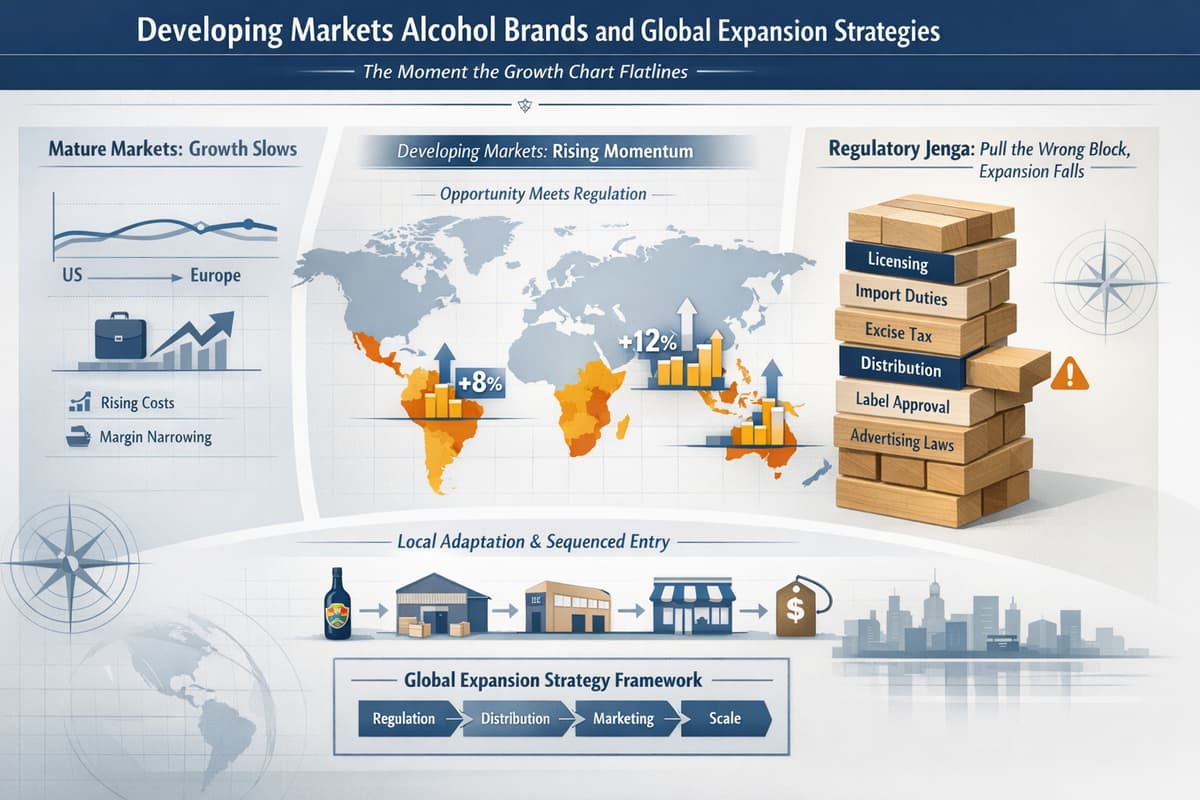
The Moment the Growth Chart Flatlines
You’re sitting in a boardroom in London or New York.
The slide deck is clean. The numbers are not.
US volume is steady, maybe dipping. Europe feels like it’s running on yesterday’s buzz. Marketing spend is up. Margins are nibbling their own edges. Someone says, “We need emerging markets.”
And they’re right.
But here’s the uncomfortable truth most executives won’t say out loud: expanding alcohol brands emerging markets isn’t a branding problem. It’s not even a distribution problem.
It’s a sequencing problem.
Because in developing markets alcohol growth looks exciting on the surface. Rising middle classes. Young populations. Premiumization trends. Instagram-ready rooftops in Mumbai and Manila.
But step wrong in the regulatory maze and the whole thing collapses like a dodgy Jenga tower at a pub on a Friday night.
One wrong pull, and down she goes.
If you want sustainable global expansion strategies alcohol leaders can actually build on, you must master what I call Regulatory Jenga first.
Not later.
First.
Why “Opportunity” Is the Most Dangerous Word in Developing Markets Alcohol
Emerging markets look irresistible on paper. India’s premium spirits demand is rising. Southeast Asia’s urban class is trading up. Parts of Africa and Latin America show long-term demographic momentum.
Recent industry insight, including analysis highlighted by IWSR, shows structural shifts toward premiumization and changing consumption habits shaping the global beverage landscape. You can explore one such outlook here: https://www.theiwsr.com/insight/five-key-trends-shifting-the-beverage-alcohol-market-in-2025
The opportunity is real.
But opportunity without regulatory literacy is like buying a Ferrari before learning to drive stick.
In premium alcohol India Southeast Asia markets, you aren’t simply launching a brand. You are navigating:
- State-by-state licensing fragmentation
- Import duties that swing wildly
- Excise calculation structures that punish premium pricing
- Distribution monopolies or semi-monopolies
- Advertising restrictions bordering on artistic gymnastics
- Enforcement inconsistency that changes by district
That’s not pessimism. That’s operating reality.
Alcohol regulations developing economies are not just complex. They are layered. Political. Sometimes opaque. Occasionally brilliant. Frequently shifting.
Many alcohol brands emerging markets fail not because consumers didn’t want them.
They fail because leadership underestimated this stack.
The Regulatory Jenga Framework: How Smart Brands Sequence Entry
Imagine each regulation as a wooden block.
Licensing. Import duties. Label approval. Distribution contracts. Tax stamps. Route-to-market compliance. Advertising approval. Warehouse permissions.
Pull the wrong block too early and your entry collapses.
So how do sophisticated global expansion strategies alcohol leaders avoid that fate?
They follow three layers of stacking.
Layer One: Structural Stability
This is your base.
Before you talk influencers or launch parties in Bangkok, you must map:
- National alcohol law framework
- Regional or state-specific variances
- Excise and customs duty modeling at multiple price tiers
- Currency volatility exposure
In India alone, state-level alcohol policies differ dramatically. Some regions encourage premium imports. Others impose burdensome taxes that choke aspiration pricing.
If your premium alcohol India Southeast Asia strategy assumes uniformity, you’re in for a proper shock.
The brands that win model three scenarios: optimistic, realistic, and “government changed the rule yesterday.”
Because sometimes they do.
Layer Two: Distribution Power Mapping
Next block.
In many developing markets alcohol ecosystems depend on mandated distributors. Some states operate government-controlled retail systems. Others require local joint ventures.
Here’s the quiet truth: the strongest distribution partner is useless if their compliance record is messy.
I once advised a founder who fell in love with a fast-moving distributor in a major African city. They had energy. Connections. Swagger.
But their licensing paperwork? Let’s say it had… personality.
Six months later, shipments were delayed due to a technicality. Cash was tied up in customs. Marketing timing collapsed.
The brand survived. Just.
Lesson? In alcohol brands emerging markets, your distributor is part of your regulatory infrastructure.
Vet them like you would a CFO.
Layer Three: Controlled Visibility
Only now do we talk marketing.
Advertising rules in alcohol regulations developing economies can be tight. Some markets prohibit lifestyle ads but allow surrogate branding. Others allow POS visibility but not digital campaigns.
Creative teams often get frustrated.
But constraint breeds strategy.
In parts of premium alcohol India Southeast Asia ecosystems, experiential marketing within licensed venues outperforms digital ads anyway. Private tastings. Hotel partnerships. Curated hospitality collaborations.
Play within the lines.
If you stack foundation first, visibility becomes amplifying fuel, not legal risk.
Premium Alcohol India Southeast Asia: A Case for Micro-Entry Before Macro Domination
There’s a myth that scale must be immediate.
It must not.
Especially in alcohol brands emerging markets.
In India and Southeast Asia, micro-entry often beats macro splash.
What does that look like?
- Single-city or single-state pilots
- Localized SKU rollout instead of full portfolio launch
- Price tier testing within one licensing bracket
- Regulatory feedback loops every 90 days
This is not hesitation. It is controlled aggression.
Premium alcohol India Southeast Asia consumers are curious. They are brand-aware. They often aspire toward global labels.
But excise structures may compress your margin more than expected. Or labeling requirements could require expensive redesigns.
Test.
Calibrate.
Then expand.
In music terms, don’t headline a stadium before you’ve tested the acoustics.
Integrating Regulatory Intelligence Into Global Expansion Strategies Alcohol Leaders Trust
If compliance sits in a dusty binder on someone’s desk, you’re already behind.
The most resilient global expansion strategies alcohol companies deploy treat regulatory intelligence as a competitive advantage.
Here’s what that looks like in practice:
- In-house regulatory dashboard mapping license timelines and renewal cycles
- Quarterly policy change monitoring with local counsel
- Excise sensitivity modeling tied directly to pricing teams
- Distributor compliance audits baked into contracts
This is not sexy work.
But neither is rebuilding reputation after a compliance breach.
Alcohol regulations developing economies don’t just impact entry. They shape long-term defensibility.
If your competitors struggle with compliance friction, and you glide through renewals and audits like a seasoned professional, guess who gains trust with authorities?
Guess who becomes the stable foreign partner?
Exactly.
Regulatory competence builds political capital.
And political capital compounds.
The Emotional Shift: From Bureaucracy Frustration to Strategic Edge
Let me speak to the feeling beneath the spreadsheets.
Many founders and executives feel annoyed by regulation.
It feels slow. Constraining. Anti-growth.
I get it.
I’m an entrepreneur. My instinct is momentum.
But here’s the reframe: alcohol brands emerging markets do not win by moving fastest.
They win by moving smartest.
Bureaucracy isn’t the enemy. It’s terrain.
And every terrain rewards those who study its curves.
When you begin to see alcohol regulations developing economies as strategic layers instead of obstacles, something shifts. Frustration becomes curiosity. Curiosity becomes plan. Plan becomes confidence.
It’s a bit like learning local etiquette before entering someone’s home.
Respect the system. Understand the history. Adapt with humility and strength.
That’s how you build staying power in developing markets alcohol ecosystems that can change with election cycles or fiscal pressures.
Red Flags That Your Regulatory Jenga Tower Is Wobbling
Before we close, let’s get practical.
If you’re already expanding into premium alcohol India Southeast Asia or other developing markets alcohol regions, watch for these signals:
- License renewals submitted last minute
- Cash flow stress tied to customs clearance delays
- Frequent “unexpected” tax adjustments
- Heavy dependency on one politically connected intermediary
- Marketing campaigns pulled after launch due to compliance queries
Each one is a loose block.
Tighten them now.
Because alcohol brands emerging markets suffer most when risk stacks quietly.
Proactive restructuring is far cheaper than crisis repair.
Trust me on that one.
The Long Game: Legacy Over Quick Wins
The global alcohol industry isn’t shrinking.
It’s shifting.
Mature Western markets are stable but competitive. Margin growth is harder. Consumer habits evolve.
Developing markets alcohol growth hubs, especially across India, Southeast Asia, Latin America, and parts of Africa, represent tomorrow’s volume and prestige plays.
But this isn’t about chasing headlines.
It’s about building brands that last 20, 30, 50 years in markets that are still defining their modern regulatory identity.
When your team masters global expansion strategies alcohol through regulatory sequencing, you do something powerful:
You reduce volatility.
You increase adaptability.
You earn trust from distributors, regulators, and consumers.
That trust is invisible on a slide deck.
But it’s priceless on a balance sheet.
So forget the glittering headline of “rapid global expansion.”
Focus on stacking wisely.
Map the laws. Model the taxes. Vet your partners. Pilot with precision. Scale with evidence.
Treat alcohol regulations developing economies as your training ground, not your burden.
Because when you play Regulatory Jenga with skill instead of impulse, the tower rises taller than your competitors imagined possible.
Stack the regulations right, and your brand doesn’t just enter; it dominates the skyline of tomorrow’s drinkers.