
Alcohol premiumization 2026 thrives in value-driven retail era
Explore 2026 alcohol premiumization trends, stealth luxury, and why consumers still trade up for meaningful bottles.
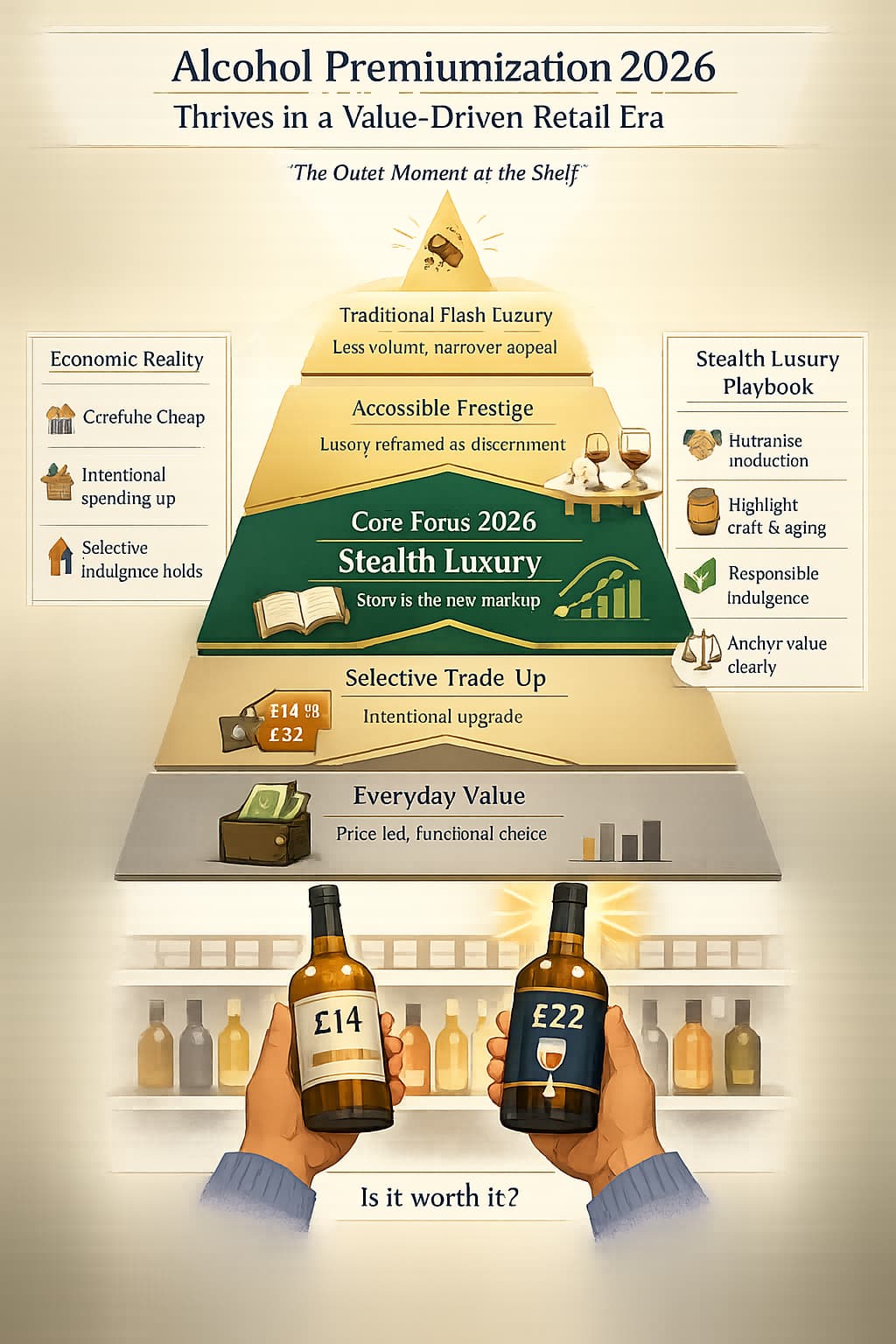
The Quiet Moment at the Shelf
You can feel it in the aisle.
A customer stands in front of your display, holding a £14 bottle in one hand and a £22 bottle in the other. Their brows pinch slightly. Rent’s up. Groceries are cheeky these days. Energy bills? Don’t even start.
They want the nicer one.
But they’re asking themselves a silent question:
“Is it worth it?”
This is the exact tension behind the search to justify premium alcohol prices economic uncertainty.
And here’s the truth most brands don’t want to admit: premiumization isn’t dying. It’s just gone undercover.
What we’re seeing in alcohol premiumization 2026 isn’t a collapse. It’s a transformation. Flashy, high-rolling luxury is taking a back seat. In its place? Something quieter. Smarter. More emotionally intelligent.
I call it stealth luxury.
It’s where everyday bottles hide Michelin-star stories.
And if you learn how to use it, value-driven retail alcohol environments won’t feel like margin graveyards. They’ll feel like opportunity.
Let’s break this down properly.
Alcohol Premiumization 2026: Not Louder, Just Smarter
Scroll across industry headlines about premium alcohol trends 2026 and you’ll notice a pattern. Words like “slowdown,” “value shift,” “consumer caution.”
And yes, shoppers are careful. Absolutely.
According to research from IWSR, there are six structural drivers shaping beverage alcohol moving forward, many tied directly to moderation, economic pressure, and drink-less-drink-better behavior. You can see the deeper analysis here: https://www.theiwsr.com/insight/six-key-drivers-shaping-beverage-alcohol-in-2026-and-beyond
But here’s what people miss.
Careful doesn’t mean cheap.
Careful means intentional.
The lipstick effect premium drinks 2026 dynamic explains this beautifully. In tough times, consumers cut big luxuries - holidays, high-end dining - but keep small, meaningful indulgences. A better bottle for Friday night becomes the affordable escape.
Not a £60 splurge.
Not bottom shelf either.
Selective trading up.
That’s the pivot.
So if you’re trying to justify premium alcohol prices economic uncertainty, the game isn’t about defending price points. It’s about reframing what “premium” feels like.
Premium now means thoughtful.
Premium means crafted.
Premium means responsible indulgence.
Not flexing.
The Rise of Stealth Luxury in Value-Driven Retail Alcohol
Let’s talk about the shelves where this battle actually happens: value-driven retail alcohol environments.
Discount grocers.
Mainstream supermarkets.
High-traffic chains.
These places aren’t killing premiumization. They’re reshaping it.
Here’s what stealth luxury looks like in practice:
- A £20 bottle that tells a heritage story previously reserved for £40 bottles.
- Packaging that feels tactile and intentional, not flashy.
- Clear sourcing transparency without pretentious language.
- Smaller batch cues embedded, not screamed.
It’s premium with its elbows tucked in.
Consumers today don’t want to feel irresponsible. They want to feel smart.
The psychological shift is huge. When someone chooses the upgraded bottle in 2026, they’re not saying, “I deserve extravagance.”
They’re saying, “If I’m drinking, I’m drinking something worth it.”
That’s how you justify premium alcohol prices economic uncertainty - you reposition premium as efficiency of pleasure.
Fewer drinks. Better experience.
Not bigger spend. Better choice.
Story Is the New Markup
Let me share something from my own consulting work.
We had a mid-tier gin brand stuck in that awkward middle zone. Too expensive to compete with entry-level. Not prestigious enough to command top-shelf prices.
Margins were fidgety.
Instead of adjusting price, we rewrote the narrative.
We reframed distillation methods. We highlighted the founder’s agricultural heritage. We pulled forward sensory storytelling - rosemary from coastal cliffs, citrus dried in winter barns, copper pot still photos that actually looked human, not factory-polished.
Sales didn’t spike overnight.
They stabilised.
Then they climbed.
Why? Because story adds psychological weight.
This is the core overlooked lever in alcohol premiumization 2026. Data shows selective trade-up behaviour is alive. The brands winning under premium alcohol trends 2026 aren’t necessarily more expensive.
They’re more meaningful.
If you want practical ways to embed stealth luxury storytelling, start here:
- Humanise production: Show real hands, not stock visuals.
- Clarify craft elements: Aging time, barrel origin, ingredient specifics.
- Frame moderation positively: Position quality as supporting drink-less-drink-better lifestyle.
- Anchor comparison subtly: “Comparable to reserve blends” without shouting.
That’s how you justify premium alcohol prices economic uncertainty without discounting.
Because discounting teaches shoppers to wait.
Story teaches them to value.
The Lipstick Effect Premium Drinks 2026 Explained Simply
Let’s bring this down to earth for a second.
When budgets tighten, people don’t eliminate joy. They edit it.
That’s the heartbeat of lipstick effect premium drinks 2026.
Instead of three average bottles for the month, someone buys one better one. Instead of cocktails out, it’s elevated pours at home. Instead of variety, it’s craftsmanship.
This trend is not theoretical. It aligns directly with macro insight shaping premium alcohol trends 2026 - intentional moderation, quality over quantity, experience-in-a-bottle positioning.
If you’re in value-driven retail alcohol, this is your edge.
You are not fighting luxury boutiques.
You’re offering accessible prestige.
It’s the difference between:
“Why is this £6 more?”
Versus
“I get why this is £6 more.”
See the nuance?
To justify premium alcohol prices economic uncertainty, replace price defense with emotional logic.
Give customers language they can repeat at dinner tables.
“That distillery’s family run.”
“They age it longer than most at this price.”
“It actually tastes smoother - we’re having less.”
You’ve turned overspending into wise spending.
That’s stealth luxury doing its quiet magic.
Embedding Premium Without Alienating Budget-Conscious Shoppers
Now let’s get tactical.
Because inspiration is lovely. But implementation pays the bills.
To win at alcohol premiumization 2026 inside value-driven retail alcohol settings, consider this framework:
1. Compress the Luxury Signals
Instead of adding features, refine the ones that matter.
- One standout ingredient.
- One strong provenance claim.
- One clear process differentiator.
Simple beats crowded.
2. Align With Moderation Culture
Consumers in premium alcohol trends 2026 are drinking less overall. Frame your bottle as the right choice for slower evenings, intentional moments, shared meals.
You’re selling quality per occasion, not volume per week.
3. Design for the Shelf Reality
Stealth luxury packaging doesn’t rely on gold foil and shouting fonts.
It leans into texture. Matte finishes. Earth tones. Confidence without glitter.
Quite frankly, if your label screams, it feels insecure.
4. Protect Margin Through Meaning
When you obsess over how to justify premium alcohol prices economic uncertainty, remember this: price objections often mask uncertainty, not resistance.
Clarity reduces friction.
Spell out value clearly. Remove guesswork. Make the upgrade obvious.
Because when premium feels rational, not reckless, shoppers lean in.
The Bigger Picture: Premium Alcohol Trends 2026 Aren’t About Wealth
Here’s the most important shift.
Premium used to signal excess.
Now it signals discernment.
The patterns shaping premium alcohol trends 2026 - moderation, wellness awareness, economic recalibration - all support this evolution.
And this is why alcohol premiumization 2026 still thrives quietly under pressure.
It’s less about showing off.
More about aligning with identity.
Consumers want to feel:
- Financially responsible.
- Culturally informed.
- Intentional in their choices.
When your bottle supports that self-image, price becomes secondary.
And within value-driven retail alcohol, this is powerful. Because your environment already signals practicality.
Add stealth luxury properly, and you give customers emotional permission to trade up - without guilt.
That’s the sweet spot.
Not champagne fireworks.
More like a perfectly set dinner table on a Tuesday.
Subtle. Considered. Worth it.
From Margin Anxiety to Strategic Advantage
If you’re feeling that knot in your stomach about shrinking baskets, downtrading whispers, margin erosion… I get it.
It’s uncomfortable.
But here’s the reframing:
Consumers aren’t rejecting premium.
They’re rejecting obvious extravagance.
When you embed craft, heritage, and story into accessible formats, you align with the lipstick effect premium drinks 2026 reality.
You stop chasing loud luxury.
You start engineering meaning.
And meaning scales.
So when someone asks how to justify premium alcohol prices economic uncertainty, the answer isn’t spreadsheets first.
It’s psychology first.
Build narrative capital.
Clarify craftsmanship.
Respect the consumer’s intelligence.
Embrace stealth luxury.
Because in 2026, the brands that win don’t scream premium - they embed it in stories that make penny-pinching feel like an upgrade.