
You know your Friday regular’s drink. Do you know his phone number?
A CTO’s guide to picking customer engagement software for a liquor store - and the questions that actually matter.
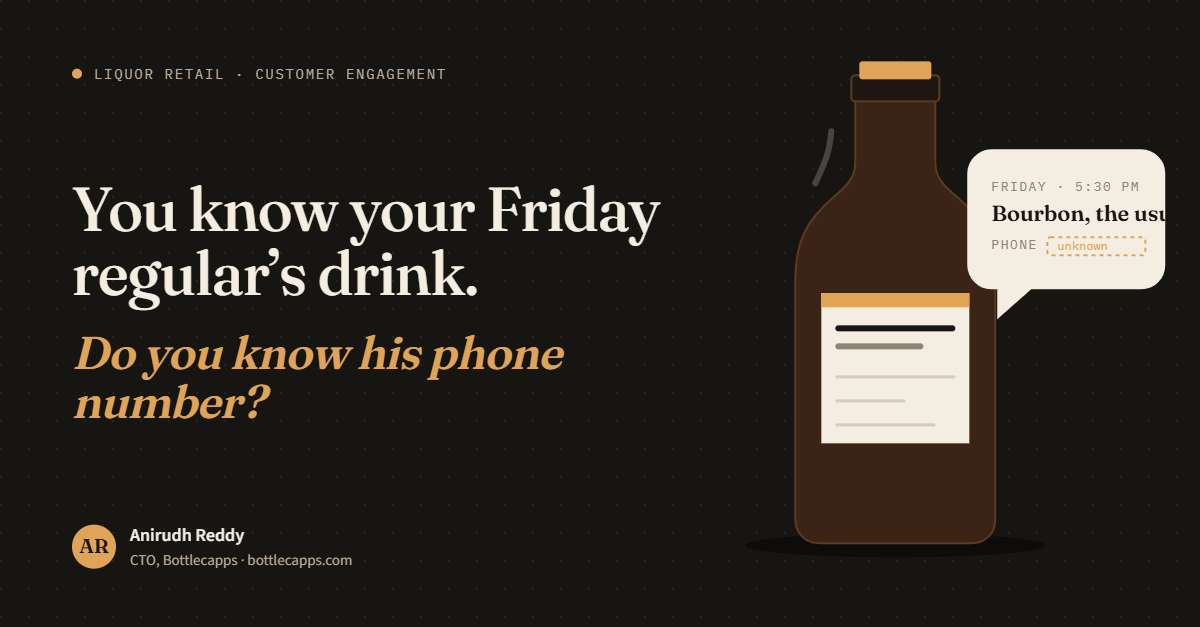
Every liquor store owner I’ve ever talked to can describe their Friday guy. Comes in around 5:30. Bourbon, usually the same one, occasionally something new if you point him at it. Been coming for years.
Then I ask: do you have his email? His phone number? Do you know if he’s been ordering from the place across town on a delivery app all week?
Almost always, no.
That gap - knowing your customers in person but not in your data - is the whole reason customer engagement software exists. I’ve spent over a decade building this stuff at Bottlecapps, and I’ve watched a lot of stores buy the wrong tool for the wrong reasons. So here’s what I’d actually look for if I were a store owner evaluating this today. Some of it is about our platform. Most of it isn’t.
Start with the POS. Everything else is downstream.
If the software doesn’t talk directly to your point of sale, stop reading the feature list. It doesn’t matter what else it does.
Here’s what happens without a real integration: a bottle sells out on the shelf at 8pm, your app still shows it in stock at 9, a customer orders it, and now your staff is making an awkward phone call. Or the price changes in the POS and the website is wrong for three days. Or your team is re-keying online orders into the register by hand.
A real integration syncs inventory and pricing automatically and pushes online orders back into the POS so your staff works from one system. Ours syncs every 30 minutes. I’ll be honest, that number matters less than the fact that it’s automatic and nobody has to think about it.
And if you run more than one location: ask whether the platform handles inventory, pricing, and delivery zones per store, under one login. If the vendor pauses on that question, the product wasn’t built for you.
Loyalty programs mostly don’t work. Here’s why.
I’ll say the quiet part: most liquor store loyalty programs are dead within 90 days. Enrollment spikes, then nothing. Not because customers don’t want rewards - because the program isn’t connected to anything.
A loyalty program that matters is one where enrolling takes ten seconds at checkout (phone number, done), points accrue automatically, and redemptions happen at the register without your cashier switching screens. More importantly, it’s one where the loyalty profile is tied to purchase history. That’s how you learn that one customer buys bourbon every two weeks, another stocks up on rosé every June, and a third only shows up in December.
We built Bottlecapps Rewards inside the same platform as the app, the website, and the messaging. No separate vendor, no extra login, no extra fee. That’s not a sales line, it’s an architecture decision - the loyalty data and the marketing tools have to be in the same place or the program becomes a chore nobody maintains.
The stores that get results treat loyalty as a lever, not a feature. They tie bonus points to slow Tuesdays. They watch which rewards get redeemed and adjust. That kind of tinkering only happens when the data is one click away.
Texts, emails, push - pick all three, from one place
Some customers read every text and never open email. Some deleted your app months ago but still check their inbox. If you only have one channel, you’re invisible to a chunk of your own customer base.
The trick isn’t having three channels. It’s having three channels that read from the same customer profile. The guy who bought a specific craft beer last month gets a text when it’s back. The wine club member gets a push about this month’s pick. The first-time online buyer gets a welcome email with a coupon.
Where I’ve seen stores get stuck is when the SMS tool, the email tool, and the app are three different vendors. Every campaign means exporting a list, uploading it somewhere else, and hoping it’s still accurate. It never is.
Segmentation is the feature nobody uses and everybody should
Blasting the same weekly deal to every customer on your list is the default. It’s also the reason unsubscribe rates are what they are.
Segmentation just means grouping customers by what they actually do. Your VIPs - the weekly regulars, the premium buyers. Your bargain hunters, who move on a case discount. Your explorers, who’ll try whatever your staff is excited about this week.
Once you know who’s who, you can stop treating them the same. VIPs get first crack at the allocated bottle. Bargain hunters get the deal alert. Explorers get the new-arrivals list. Same effort on your end, but every message lands with someone who cares.
The catch: segmentation is only as good as the purchase data behind it. Without POS history, you’re guessing. We build it into the platform using purchase history, engagement, and loyalty activity, and the segments feed straight into SMS, email, and push. No CSV in the middle.
Don’t pick software off a feature list
I’ve watched stores sign up for a platform with hundreds of features and use four. The question that matters is whether your numbers moved.
The numbers I’d watch: retention (do first-time buyers come back?), average basket, visit frequency, online conversion rate, and repeat purchase rate. That’s it. Five numbers.
Then connect them to what you did. You sent a push about a new bourbon last Tuesday - did those customers buy more than the ones who didn’t get it? You ran a double-points day - did traffic go up? If your platform can’t answer that without a spreadsheet, it’s not really telling you whether it’s earning its monthly cost.
Was it built for liquor, or adapted to it?
Generic e-commerce can sell alcohol. Technically. But liquor has age verification on delivery, state-by-state rules, bottle deposits in some places, app store restrictions on certain categories, and a catalog problem - thousands of SKUs that all need images, descriptions, ABV, varietal.
Ask any vendor: do I have to build my catalog from scratch? Ours matches your POS inventory against a library of over 5 million products and fills in the images, tasting notes, and attributes for you. Nobody should be photographing bottles on a Sunday.
And ask about marketplaces. If your DoorDash, Instacart, and Uber Eats orders land in a different system than your app orders, you’ve got two fulfillment workflows and twice the mistakes.
The one thing I’d measure everything against
One system. Register, app, website, marketing, customer data, all talking to each other. Every day those pieces stay separate, you’re losing data you’ll never get back and spending staff hours on work software should be doing.
Your Friday guy is going to keep coming in either way. But the store that has his number is the one that gets him on a Tuesday too.
If you want to see what your store’s data would look like in one place, book a walkthrough - or just get in touch. I’d rather have the conversation than sell you anything.