
The Digital Shelf Has Reached Beverage Alcohol’s Tipping Point
How eCommerce and Retail Media Are Reshaping the Three-Tier System
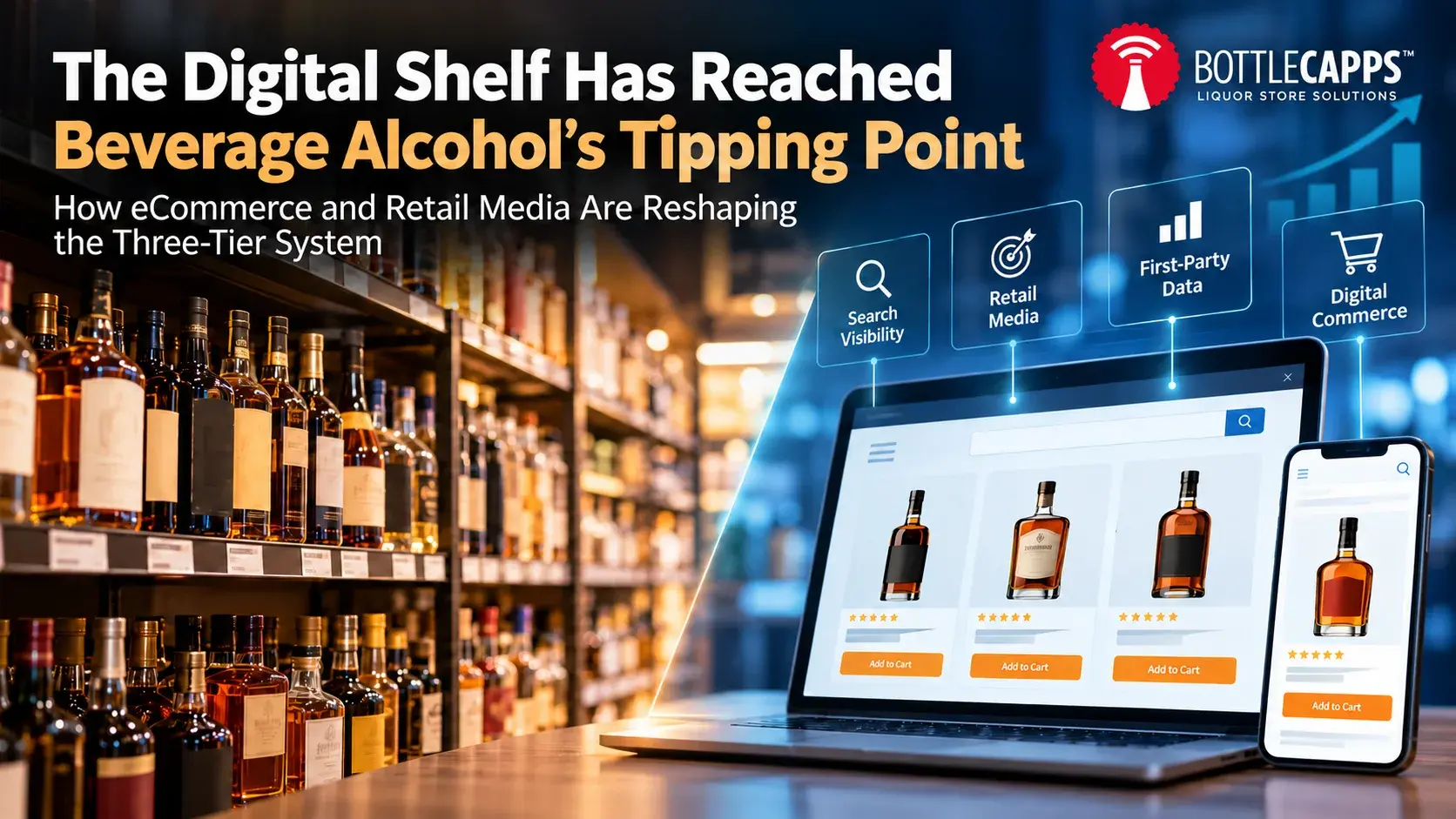
For decades, success in beverage alcohol retail was largely determined by distribution, physical shelf space, in-store displays, and promotional support. Brands competed for visibility in liquor stores, grocery aisles, and other permitted retail environments, while distributors helped connect suppliers with retailers and consumers.
Today, another competitive battleground is emerging: the digital shelf.
As consumers increasingly use online channels to discover products, compare options, read reviews, and locate retailers, digital visibility is becoming an important part of beverage alcohol marketing and commerce. At the same time, retail media networks are creating new opportunities for retailers to monetize their digital audiences and for brands to reach shoppers closer to the point of purchase.
The beverage alcohol industry has unique regulatory and distribution requirements that distinguish it from other consumer packaged goods categories. However, these differences do not eliminate the impact of digital transformation. They make it particularly important for industry participants to understand how online discovery, retail media, and consumer data are changing the competitive landscape.
The question is no longer whether digital channels matter to beverage alcohol. It is how brands, retailers, and distributors will adapt as those channels become more influential.
The Industry Assumed Alcohol Was Different
For years, beverage alcohol appeared relatively insulated from the digital disruption affecting other retail categories.
Several factors contributed to this perception:
- Regulatory restrictions and age-verification requirements introduce additional complexity.
- Distribution rules and permitted sales channels vary by state and jurisdiction.
- Retail availability depends on licensing, local regulations, and distribution arrangements.
- Physical stores remain important places for product discovery and purchase.
- Traditional trade marketing, distributor relationships, and in-store promotions continue to influence brand performance.
These factors distinguish alcohol from categories such as electronics, books, and general merchandise. They also mean that digital commerce cannot simply follow the same model across every market.
However, consumer expectations continue to evolve. Shoppers routinely use digital platforms to research products, compare prices, check availability, and make purchasing decisions across retail categories. Beverage alcohol consumers can apply similar behaviors even when the final transaction must occur through a licensed retailer or another legally permitted channel.
Online ordering, curbside pickup, and delivery where permitted have expanded the ways consumers can access alcohol. Meanwhile, digital search, retailer websites, product reviews, and mobile applications influence what shoppers discover before entering a store.
Digital transformation in beverage alcohol is therefore about more than online sales. It is also about how consumers find products, evaluate brands, and decide where to buy them.
The Rise of the Beverage Alcohol Digital Shelf
Historically, winning in beverage alcohol retail meant securing distribution, shelf placement, displays, features, and promotional opportunities.
Those fundamentals remain important. But brands must increasingly consider how their products appear across digital retail environments.
The digital shelf includes retailer product pages, search results, category listings, online marketplaces, ratings, reviews, and other digital touchpoints that influence product discovery.
Unlike a physical shelf, a digital shelf is shaped by search algorithms, product data, filters, sponsored placements, and availability signals. Two products stocked by the same retailer may receive very different levels of online visibility.
Several factors can influence a product’s digital performance:
- Search visibility: Products appearing prominently in relevant search results have more opportunities to be discovered by shoppers.
- Product content: Accurate descriptions, clear product images, relevant attributes, and complete specifications help consumers understand what they are considering.
- Ratings and reviews: Where available, customer feedback can influence confidence and product consideration.
- Availability: A product that appears unavailable or has incomplete inventory information may lose consideration even when consumer interest exists.
- Retail media placements: Sponsored search results, category promotions, and other retailer-controlled advertising opportunities can increase visibility.
These factors make digital shelf management an increasingly important consideration for beverage alcohol brands.
Physical distribution determines where a product can be purchased. Digital visibility helps determine whether a shopper finds it in the first place.
Retail Media Is Changing the Economics of Trade Marketing
For decades, beverage alcohol suppliers have invested in trade marketing activities such as in-store displays, promotional features, price reductions, and shopper marketing programs.
Retail media introduces another way to influence purchasing decisions.
Retail media networks allow retailers to offer advertising opportunities through their digital properties and, in some cases, through off-site channels using retailer audience data. Depending on the retailer and program, these opportunities may include:
- Sponsored product placements in search results
- Digital category promotions
- Retailer website and app advertising
- On-site display advertising
- Email and loyalty-program placements
- Off-site advertising informed by retailer audiences
For retailers, retail media can create an additional revenue stream beyond traditional product sales. For brands, it can provide access to shoppers in environments where they are actively researching or considering purchases.
This changes the way marketing investments can be evaluated. Instead of measuring activity only through impressions, promotional participation, or distribution gains, marketers can increasingly examine performance indicators such as product engagement, attributable sales where measurement is available, and return on advertising spend.
However, beverage alcohol retail media is not a uniform or unrestricted opportunity. Advertising availability, audience targeting, transaction permissions, and measurement capabilities vary by retailer and jurisdiction. Programs must comply with applicable alcohol advertising rules, platform policies, and age-related requirements.
For brands evaluating retail media, the priority should be to identify opportunities that are legally permitted, measurable, and aligned with their distribution and marketing objectives.
First-Party Data Is Becoming a Strategic Advantage
Traditional beverage alcohol reporting has often emphasized sales volumes, market share, distribution, and other aggregated performance measures. These indicators remain valuable, but they do not always reveal how individual shoppers discover and evaluate products.
Digital retail environments can provide additional insights, subject to retailer capabilities, consumer consent, privacy requirements, and data-sharing agreements.
These insights may include:
- Shopping and purchase patterns
- Purchase frequency and repeat behavior
- Basket composition
- Product and category preferences
- Response to promotional activity
- Engagement with digital advertising
Retailers with established loyalty programs and digital commerce platforms may be particularly well positioned to understand shopping behavior within their own ecosystems.
For suppliers, access to appropriate retailer insights can help inform campaign planning, product positioning, and promotional decisions. It can also help teams assess whether digital marketing activity is contributing to measurable business outcomes.
Yet first-party data should not be treated as a resource that suppliers automatically own or can freely access. Retailers control much of the customer relationship and determine what information can be shared under their policies and applicable laws.
The strategic opportunity lies in developing stronger measurement and collaboration practices while respecting consumer privacy and data governance requirements.
What the Digital Shift Means for Beverage Alcohol Retailers
Retailers are central to the evolution of the digital shelf because they control many of the environments in which products are discovered and purchased.
Retailers that invest in effective digital merchandising, accurate product information, useful search experiences, and customer engagement can improve the shopping experience while creating new opportunities for commercial partnerships.
Retail media may also allow retailers to monetize their digital audiences through advertising programs that complement their traditional retail operations.
However, these opportunities require more than selling advertising placements. Retailers need reliable product catalogs, strong digital experiences, appropriate audience safeguards, and measurement systems that help demonstrate value to advertising partners.
For independent liquor stores and regional retailers, the opportunity may look different from that of a national grocery or mass-merchandise chain. Their competitive advantage may come from local relevance, knowledgeable service, curated selections, community relationships, and accurate digital product information.
The objective is not necessarily to replicate the infrastructure of a large retail media network. It is to identify the digital capabilities that best support each retailer’s customers and business model.
How Suppliers Can Prepare to Compete on the Digital Shelf
As digital discovery becomes more important, beverage alcohol suppliers should evaluate whether their current marketing and commerce strategies adequately account for online visibility.
Several practical steps can help establish a stronger foundation.
- Audit digital product listings. Review product descriptions, images, specifications, and other available information across relevant retailer websites. Correct inconsistencies and fill missing information wherever possible.
- Understand digital availability. Work with appropriate retail and distribution partners to identify gaps between expected product availability and what shoppers see online.
- Evaluate retail media opportunities. Determine which retailers offer suitable advertising programs, what audiences can be reached, and how campaign outcomes can be measured.
- Connect content and commerce. Ensure that brand websites, product information, retailer listings, and marketing materials communicate a consistent and accurate product story.
- Establish meaningful performance measures. Track relevant indicators such as search visibility, product-page engagement, advertising performance, and sales outcomes when reliable data is available.
- Coordinate across teams. Digital shelf performance should not sit exclusively with marketing. Sales, trade marketing, eCommerce, distribution, and analytics teams all have a role in connecting digital activity with commercial execution.
These actions do not replace established priorities such as distribution, retailer relationships, and in-store execution. They extend those priorities into the digital environments where consumer decisions increasingly begin.
The Distributor’s Role in an Evolving Three-Tier System
The three-tier system remains a defining feature of U.S. beverage alcohol distribution. Digital transformation does not eliminate the roles of suppliers, distributors, and retailers, nor does it remove the regulatory framework governing their activities.
Instead, it raises questions about how each tier can contribute to demand generation and execution in an increasingly connected retail environment.
Distributors continue to provide essential services, including logistics, market coverage, account relationships, and local execution. Their knowledge of retailer needs and market conditions remains valuable.
As digital capabilities expand, additional opportunities may emerge around digital product information, coordination with retail partners, market-level performance insights, and the alignment of marketing activity with product availability.
Suppliers may increasingly value partners who can help connect digital demand signals with physical market execution. Retailers may benefit from more accurate product information and better coordination with their supply partners.
The opportunity is not to replace traditional distribution responsibilities. It is to strengthen collaboration between physical distribution and digital commerce while respecting the rules governing each participant’s role.
The Next Frontier: Connecting Digital Discovery With Physical Retail
The next phase of beverage alcohol commerce will be shaped by how effectively companies connect consumer discovery, marketing influence, product availability, and the final purchase.
Retail media can help brands reach shoppers in relevant retail environments. Digital shelf optimization can improve product discoverability. Better data and measurement can help businesses understand which activities are working.
But these capabilities are most useful when they operate together.
A campaign may generate interest without producing sales if the advertised product is unavailable. A well-stocked product may underperform online if its listing is incomplete or difficult to find. A strong digital presence may be difficult to evaluate without appropriate measurement.
These are connected commercial challenges, not isolated marketing problems.
The businesses best positioned to adapt will be those that treat digital execution as part of their broader commercial strategy rather than as a separate initiative.
For beverage alcohol, that means combining the strengths of the existing three-tier system with a more deliberate approach to digital discovery, retail media, product information, and performance measurement.
Conclusion: The Digital Shelf Is Becoming Too Important to Ignore
Beverage alcohol will not follow exactly the same digital transformation path as books, electronics, toys, or grocery. Regulation, distribution structures, and purchasing requirements create meaningful differences.
Nevertheless, the broader retail lesson is relevant: consumer discovery can shift before an entire category’s transactions move online.
For beverage alcohol brands, retailers, and distributors, that distinction matters. Digital channels can influence consideration and purchasing decisions even when the transaction ultimately occurs in a physical store or through a legally permitted retail channel.
The next competitive advantage may depend not only on securing physical distribution, but also on making products easier to discover, evaluate, and purchase across digital touchpoints.
The physical shelf remains important. But the digital shelf is becoming an increasingly consequential part of the path to purchase.
The question for beverage alcohol businesses is no longer simply where their products are stocked. It is whether consumers can find them when and where they are looking.